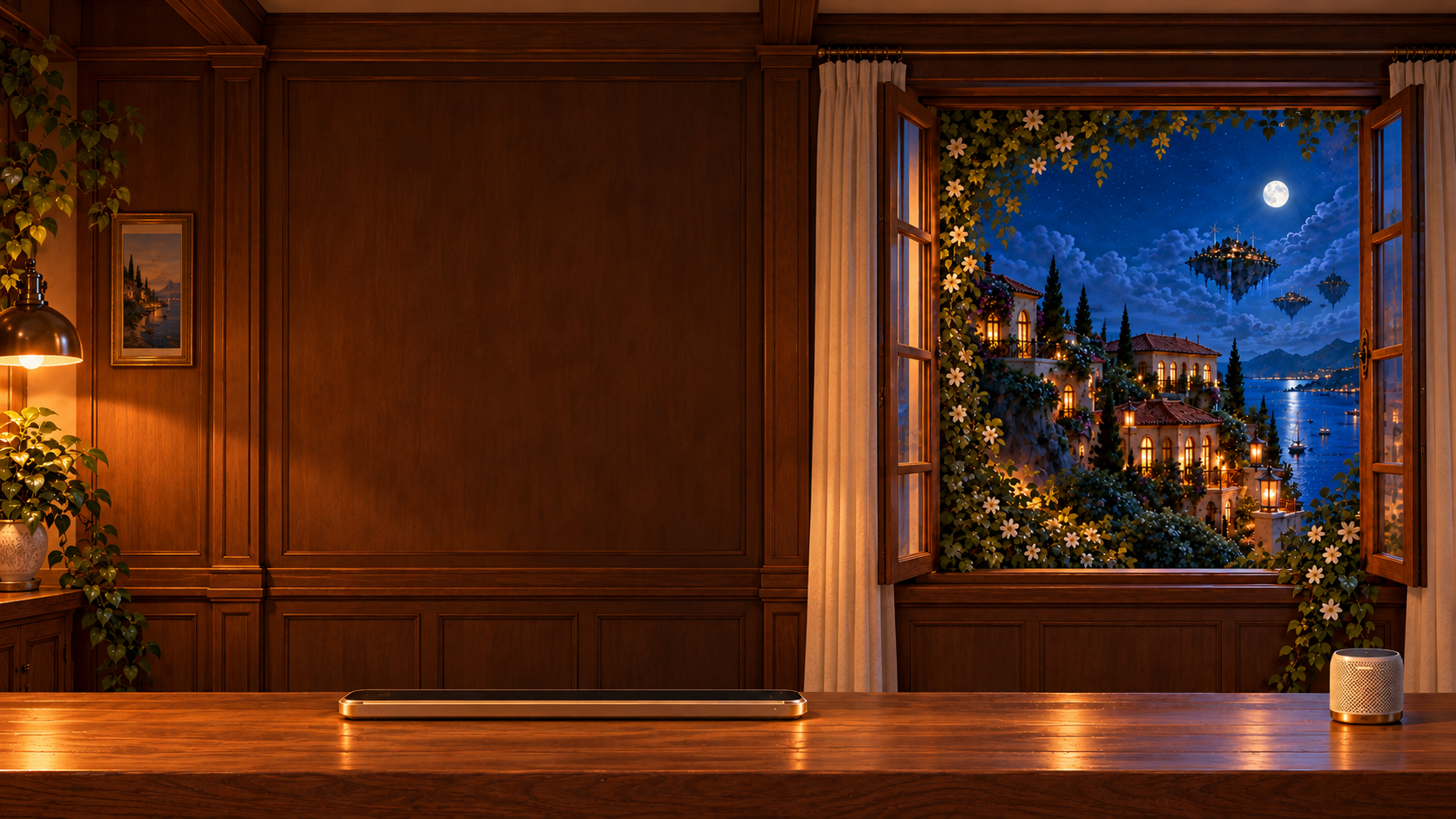
An evening in the floating village
A little room for possibility.
Beyond the window, the village is settling into the evening. A few lights remain in the greenhouse. Beyond the terraces, moonlight settles across the water.
This is a place to slow down and follow a thought for a while. The desk is clear enough to begin, and the world outside is there whenever you look up. Some evenings are for making things. Others are simply for noticing what has been there all along.
During the day, the paths between the houses are full of small errands: someone carrying seedlings, a neighbour returning a book, a child stopping to watch the water tumble over the edge. At night, those same paths become lines of warm light, connecting one room to the next.
The view from here
The ocean changes colour long before the sky grows dark. The bright turquoise of the shallows becomes a deeper blue, and the distant islands begin to lose their edges. Then the first window lights appear. The village seems smaller and more personal, made up of kitchens and conversations rather than buildings.
From this room, you can see the terrace across the way and the curve of the steps beneath it. There is a table where someone has left a cup. A climbing plant has found its way around the railing. These are the small signs of a place being lived in.
The light above the desk is only one part of the room. A small music player sits beside the window, leaving the desk clear for whatever comes next. Having room to work also means having room to leave something unfinished.
Making time for the details
A good idea rarely arrives fully formed. More often it begins as a question, or a shape that keeps appearing in the margin of a notebook. You try something, step back, and notice what the first attempt has taught you. The next version does not need to be bigger. Sometimes it only needs to be clearer.
There is a kind of attention that becomes easier in a quiet room. You begin to see the difference between a useful detail and a distracting one. You let a sentence breathe. You leave space around the thing that matters, trusting that it can hold its own.
Outside, the lights along the bridge are reflected in the mist. The waterfall is too far away to hear distinctly, but its movement gives the stillness a rhythm. The room holds both things at once: the quiet of an evening indoors, and the sense that the wider world is continuing beyond it.
A place to return to
Tomorrow, the same window will open onto a different morning. The desk will still be here. So will the unfinished sketch and the idea that seemed almost ready before you closed the notebook. You do not have to solve everything tonight.
For now, there is enough light to read another page.
CHUN · Notes from the village.